UAE SME Bookkeeping: Your 2026 Compliance Guide
You started the business to win clients, build revenue, and keep operations moving. Then the paperwork began to pile up. Supplier invoices sit in one inbox, receipts live in WhatsApp, customer payments hit the bank without clean references, and now someone has asked for VAT support, expense proof, or year-end numbers.
That's the point where many owners realise bookkeeping in the UAE isn't a simple admin task. It's the working file behind tax, finance, reporting, and credibility. If the books are weak, everything built on them is weak too.
Good UAE SME bookkeeping does more than record history. It gives you clean numbers for decisions, support for tax positions, and records that can stand up to review. It also has to evolve. The system that works when you're a small owner-managed business often breaks once you register for VAT, add staff, manage projects, or move into the Corporate Tax environment. That shift is where many SMEs run into avoidable trouble.
Why Your UAE SME Cannot Afford to Ignore Bookkeeping
Most new SME owners treat bookkeeping as something they'll tidy up later. That works until a bank asks for proper financials, a tax return is due, or an expense needs supporting evidence and no one can find the invoice.
The commercial cost of weak records is easy to underestimate. A Central Bank of the UAE MSME survey found that service and trade firms make up over 86% of businesses surveyed, and nearly half of micro enterprises in the services sector lack audited financial accounts. Among those, 91% were financially constrained, which directly links poor records to weaker financing access and tighter borrowing outcomes, according to the Central Bank of the UAE MSME survey report.
Poor books create practical business problems
If you run a service company, a small contracting business, a property-related operation, or a trading setup, bookkeeping affects more than tax. It affects whether you can answer basic questions quickly:
- Can you prove revenue clearly: Lenders, investors, and even potential partners want numbers they can follow.
- Can you support expenses properly: If the paperwork is incomplete, deductions become harder to defend.
- Can you see cash pressure early: A profitable month on paper can still hide collection problems, overspending, or project leakage.
Bookkeeping also changes as the business grows. Early on, you may only need a disciplined system for invoices, payments, and bank matching. Later, you need books that can support VAT coding, expense substantiation, and year-end tax adjustments.
Practical reality: In the UAE, bookkeeping starts as organisation. Very quickly, it becomes compliance infrastructure.
That's why owners searching for ways to strengthen their finance function often begin with the basics of why bookkeeping is important for businesses, then realise the deeper issue isn't whether bookkeeping matters. It's whether their current process is strong enough for the next stage of the business.
Growth exposes weak systems
A business can survive messy records for a short period. It can't scale on them. Once transaction volume rises, one missed document or one misposted entry stops being a small clerical issue. It starts affecting VAT treatment, reporting accuracy, and confidence in the numbers.
That's why UAE SME bookkeeping should be built for the business you're becoming, not just the business you were when you opened the bank account.
Understanding Your Core Bookkeeping Obligations in the UAE
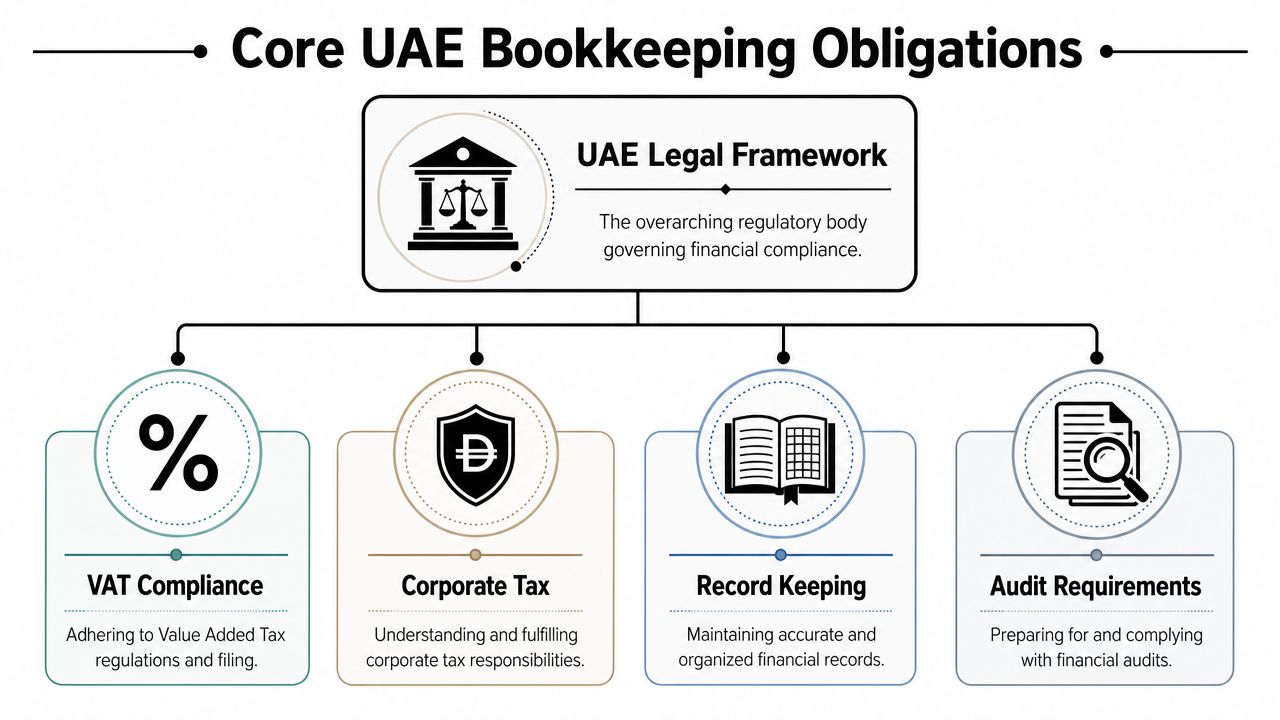
UAE bookkeeping rules are straightforward in principle and demanding in practice. The principle is simple. If you carry on business, you must maintain records that support what you sold, what you bought, what tax applied, and how those figures tie back to your books.
For SMEs, the legal environment now centres on two tax regimes. VAT applies at 5% and Corporate Tax applies at 9% on profits above AED 375,000, with businesses legally required to keep financial records for at least 5 years, extending to 15 years for real estate-related companies, as outlined in this UAE small business bookkeeping guide.
What the authorities expect from your books
Many owners assume bookkeeping means keeping a sales file and a list of expenses. That's too narrow. Your records need to support the transaction from source document to accounting entry.
That usually means keeping:
- Sales support: Tax invoices, credit notes, contracts, and customer receipts
- Purchase support: Supplier invoices, debit notes, approvals, and payment evidence
- Bank support: Statements, transfer proof, and reconciliations
- Commercial support: Agreements, amendments, and any document that explains why a transaction happened
If your ledger shows an expense but you can't support it with the underlying paperwork, the entry becomes difficult to defend.
Record-keeping benchmark: Keep financial records for at least 5 years, and for some real estate transactions the period can extend to 15 years.
VAT and Corporate Tax rely on the same discipline
Owners sometimes think VAT bookkeeping and Corporate Tax bookkeeping are separate systems. They aren't. They draw from the same underlying records.
For VAT, you need accurate invoice capture, tax coding, and clean treatment of output and input tax. For Corporate Tax, you need reliable profit tracking, support for expenses, and year-end records that reflect the true events in the business. If the bookkeeping is sloppy, both filings suffer.
A practical way to think about it is this:
| Area | What bookkeeping must do |
|---|---|
| VAT | Track taxable sales and purchases with accurate supporting documents |
| Corporate Tax | Show reliable profit, expense support, and defensible year-end balances |
| Audit readiness | Let someone independent follow the trail from report to ledger to source file |
Retention is not the same as accessibility
A common mistake is keeping records somewhere, but not keeping them in a usable form. A receipt buried in a chat thread or an invoice saved on one employee's laptop doesn't help much when you need it under time pressure.
Build your system so documents are centralised, consistently named, and linked to transactions. If you use Xero, QuickBooks, or Zoho, attach support to the transaction where possible. That saves time later and reduces the risk of unsupported balances at filing time.
What this means for a new SME owner
If you're new to the UAE market, don't think of bookkeeping as a year-end clean-up exercise. Think of it as the evidence layer of your business. The books must explain the numbers, and the paperwork must support the books.
That standard sounds strict because it is. But once the system is set up properly, compliance becomes much more manageable.
How to Set Up Your Bookkeeping System from Scratch
A clean start matters. If you begin with the wrong structure, every month becomes a repair job. If you begin with the right structure, the books become easier to maintain, easier to review, and far more useful.
The first decision is the platform. Most SMEs are well served by cloud accounting software such as Xero, QuickBooks, or Zoho. The software itself won't keep you compliant. What it does is give you a workable place to organise transactions, attach documents, and produce reports consistently.
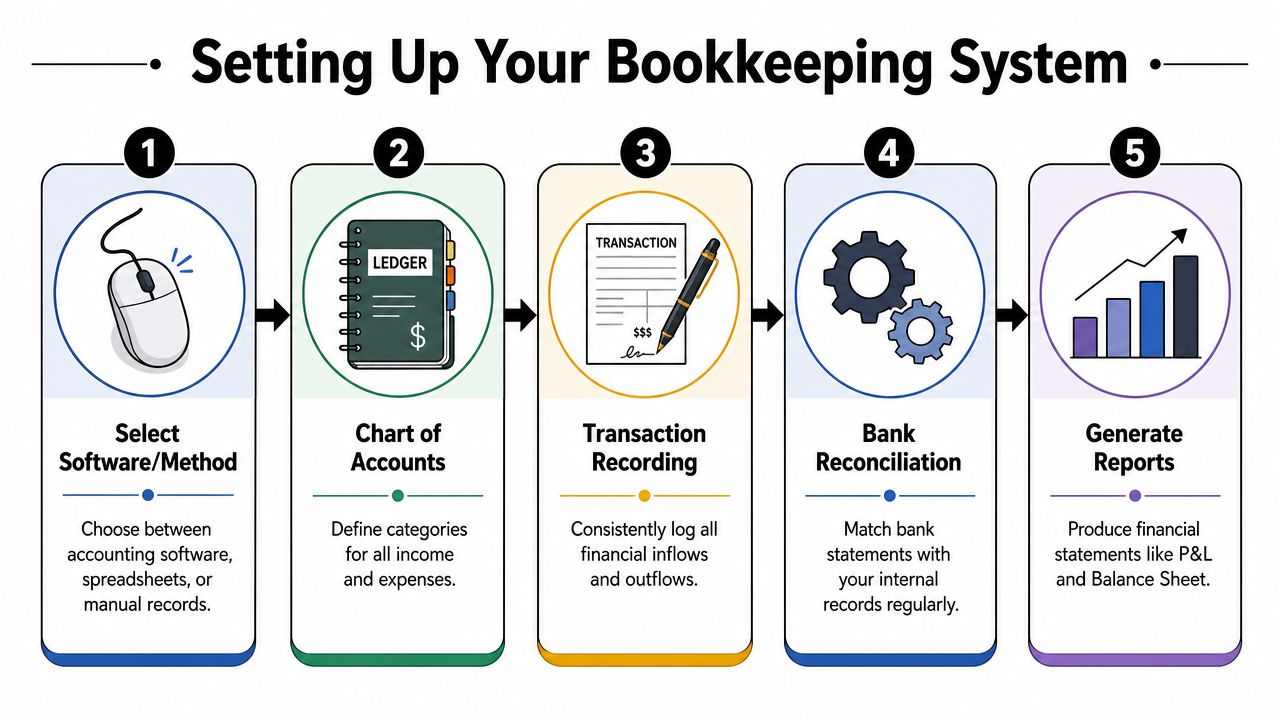
Step one chooses the method, not just the app
Don't pick software based only on price or a sales demo. Pick it based on how your business operates.
Ask practical questions:
- Do you invoice clients regularly: Then invoicing workflow and receivables tracking matter.
- Do you have project costs: Then coding by job, client, or cost centre matters.
- Do you handle many supplier bills: Then approval flow and document storage matter.
- Do you operate across currencies: Then currency handling matters.
If you're completely new to the process, this easy-to-follow bookkeeping guide is a useful companion to the more UAE-specific setup decisions discussed here.
Step two builds the chart of accounts
Your chart of accounts is your financial filing cabinet. If the drawers are badly labelled, staff will put things anywhere. Then your reports become unreliable.
A practical UAE SME chart of accounts should usually include:
- Assets: Bank accounts, receivables, prepayments, fixed assets
- Liabilities: Payables, accruals, loans, tax-related balances
- Income: Service revenue, project income, product sales, other income
- Expenses: Rent, payroll, software, subcontractors, marketing, professional fees
The categories should match how you run the business. A consultant doesn't need the same detail as a construction subcontractor. A property management company may need separate accounts for client-related flows, disbursements, and operational overhead.
For a more detailed UAE-focused structure, this guide to chart of accounts setup in the UAE is worth reviewing before you finalise the ledger.
Step three defines your bookkeeping rules
Software setup is only half the job. You also need rules that people follow.
Examples:
- Every sale needs support. Issue invoices consistently and save contracts or approvals where relevant.
- Every expense needs evidence. No posting from memory. No unexplained card transactions.
- Business and personal spending stay separate. Once those are mixed, cleanup takes time and judgement.
- Posting happens on a schedule. Backlogs create errors, especially around VAT coding and cut-off.
If a transaction can't be explained by someone outside the business, it hasn't been recorded well enough.
The video below gives a useful visual walkthrough of bookkeeping basics and can help owners understand the operating rhythm before they hand the work to staff or an external provider.
Step four connects the bank and opening balances
Many setups go wrong when owners import transactions and start posting without reconciling opening balances properly. Then the reports look active, but they aren't reliable.
Before you go live:
| Setup item | What to verify |
|---|---|
| Opening bank balance | Matches the actual bank position at the start date |
| Receivables | Unpaid customer invoices are loaded correctly |
| Payables | Supplier bills outstanding at the start date are complete |
| Owner funding | Capital injected by owners is posted properly, not treated as sales |
Step five starts with discipline, not perfection
You don't need an elaborate finance department to begin. You need a structure that captures the basics correctly and consistently.
That means:
- Post regularly
- Name files clearly
- Attach support
- Review reports monthly
- Fix coding errors early
A modest system run well beats an advanced system run badly. That's true for every form of UAE SME bookkeeping.
Essential Workflows for Clean and Compliant Books
Once the system is live, the essential work begins. Bookkeeping quality is determined less by the software you chose and more by the habits you keep. Clean books come from repeatable routines.
UAE tax expectations make that routine more important. Taxable persons must keep accounting records and supporting documents for at least seven years, and for service businesses a weekly document capture cycle is the practical benchmark to reduce misclassified VAT and ensure expenses are properly supported, as explained in this UAE SME bookkeeping systems guide.
Run a weekly capture cycle
If you wait until month-end to collect invoices, receipts, and proofs of payment, entries get delayed and context gets lost. Staff forget what the expense was for. Supplier documents go missing. The bookkeeping turns into reconstruction rather than recording.
A weekly capture cycle is a better operating rhythm.
- Collect documents: Pull supplier invoices, receipts, contracts, and payment support into one central folder.
- Post current activity: Enter sales, supplier bills, expense claims, and bank items while the details are still fresh.
- Review coding issues: Query anything unclear immediately rather than guessing.
- Attach support: Link the document to the transaction in the accounting system where possible.
For service businesses, this matters because many costs look similar on the surface but need different treatment in the books.
Reconcile the bank every month without fail
Monthly bank reconciliation is essential. It confirms that your ledger matches reality.
The process is simple in concept. You compare the bank statement to the cash book, clear matched items, investigate anything missing, and resolve timing differences. In practice, the value lies in catching problems early:
- Duplicate postings
- Missed customer receipts
- Unrecorded bank charges
- Owner withdrawals posted incorrectly
- Supplier payments without matching bills
A bookkeeping file that hasn't been reconciled isn't finished. It's only partially recorded.
Build an audit-ready document trail
Digital storage works well only when it's structured. A folder called “accounts” with hundreds of random PDFs is not a system.
Use a naming standard and keep the structure simple:
| Folder area | Typical contents |
|---|---|
| Sales | Customer invoices, credit notes, contracts |
| Purchases | Supplier bills, expense claims, approvals |
| Bank | Statements, transfer advice, reconciliation support |
| Tax | Filed returns, workings, supporting schedules |
This gives you a defendable trail when someone asks how a balance was built.
Close the month properly
Many SMEs think posting transactions is the month-end close. It isn't. A proper close also includes a brief review.
Check:
- Unusual expense spikes
- Outstanding receivables
- Supplier balances that don't make sense
- Bank items sitting unreconciled
- Transactions posted to vague codes like misc expenses
That review takes less time when the weekly discipline is strong. It also gives the owner something more useful than raw data. It gives a set of numbers you can trust.
Choosing Your Path DIY Software or Outsourced Services
Most SME owners eventually face the same fork in the road. Do you keep bookkeeping in-house using software, or do you hand it to an outside team that handles it for you?
There isn't one correct answer for every business. The right choice depends on transaction volume, internal discipline, owner involvement, and how much risk you're prepared to carry personally.
When DIY works well
DIY bookkeeping with Xero, QuickBooks, or Zoho can work if the business is still operationally simple and the owner is disciplined.
It tends to suit businesses where:
- Transactions are manageable: You can identify what each receipt and payment relates to without guesswork.
- The business model is straightforward: One main revenue type is easier to code and review.
- The owner stays close to the numbers: Someone checks postings, documents, and reconciliations regularly.
- The risk profile is still modest: Fewer moving parts means fewer chances for errors to hide.
The main advantage is control. You see the transactions as they happen and can keep costs lean. The main weakness is consistency. Once the business gets busy, bookkeeping is often the first task owners postpone.
When outsourced support becomes the better decision
Outsourcing becomes sensible when bookkeeping stops being clerical and starts requiring judgement, review, and compliance awareness.
That point often arrives when:
- You're registered for VAT
- You need cleaner management reports
- You're preparing for funding or lender discussions
- You've hired staff and the volume has increased
- The books need regular cleanup, not just posting
A provider of accounting services in UAE can take the processing work, reconciliation discipline, and review burden off the owner's desk. That matters because delayed bookkeeping rarely stays a bookkeeping problem. It spreads into tax, cash flow, reporting, and decision-making.
For owners evaluating the outsourced route, this overview of outsourced bookkeeping in the UAE is useful for understanding what responsibilities typically move outside and what still needs owner input.
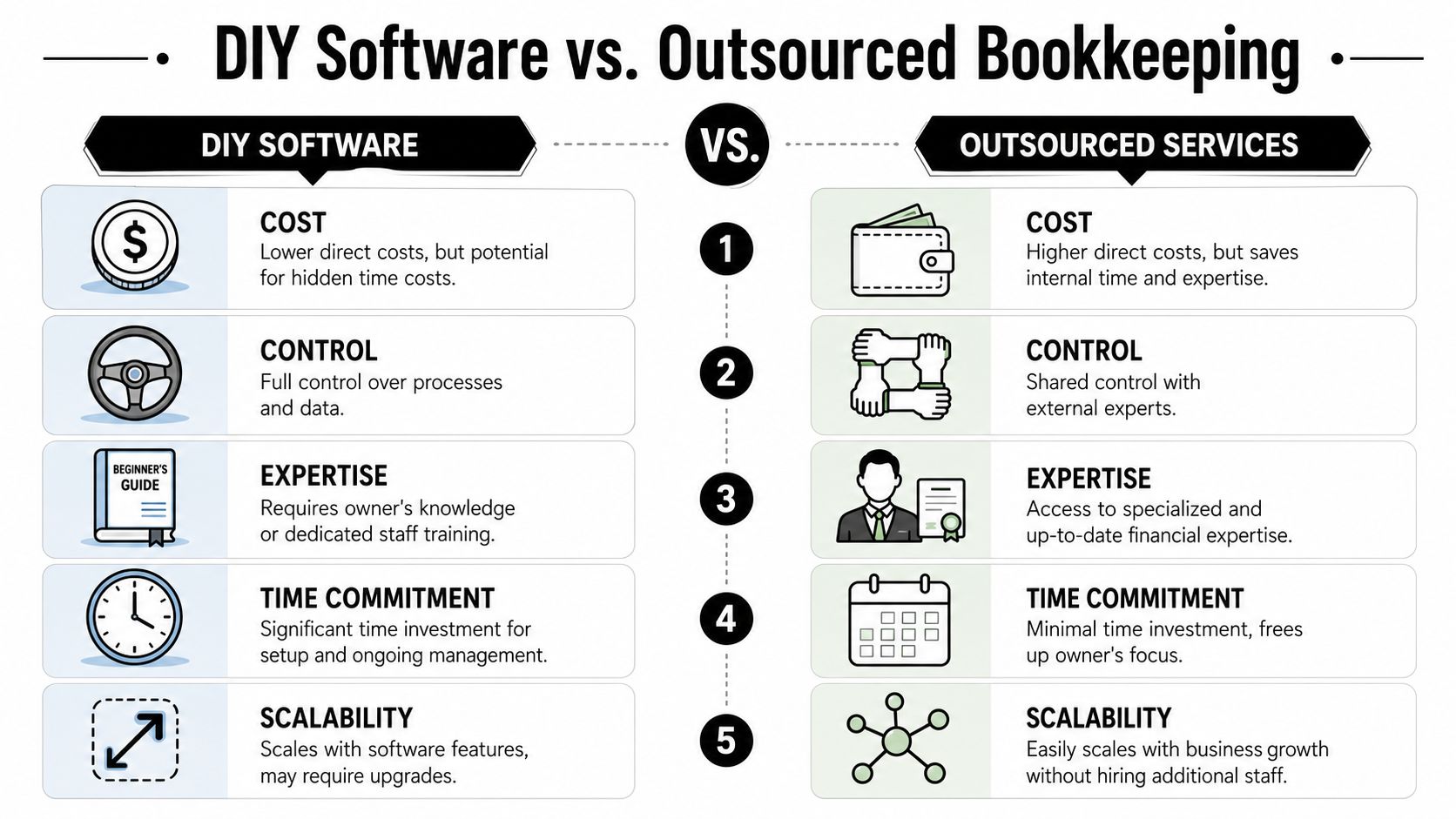
A balanced comparison
| Factor | DIY software | Outsourced services |
|---|---|---|
| Direct cost | Lower visible spend | Higher visible spend |
| Owner time | Higher time burden | Lower internal time burden |
| Control | Immediate hands-on access | Shared process with external team |
| Expert review | Depends on owner/staff capability | Usually built into the service |
| Scalability | Can strain as complexity rises | Easier to expand with growth |
The cheaper option on paper often becomes the expensive option if the owner spends too much time fixing mistakes, chasing documents, or correcting tax treatment later.
One practical middle ground is a hybrid model. The business handles front-end document collection and approvals, while an outside team manages posting, reconciliation, and reporting. Escrow Consulting Group is one example of a firm that provides outsourced bookkeeping and wider compliance support for SMEs in the UAE.
That model works well for businesses that want visibility without building a full internal finance function.
Advanced Bookkeeping as Your Business Grows
A bookkeeping system that suits a small owner-led business often fails once the company starts crossing operational and tax thresholds. Growth doesn't just create more transactions. It changes the type of bookkeeping you need.
A major challenge for UAE SMEs is that they cross compliance thresholds at different times, first VAT and later Corporate Tax, while common errors such as mixing personal and business funds or delaying entries become much more costly as the business grows, as noted in this discussion of common bookkeeping mistakes for UAE businesses.
What changes after VAT registration
Before VAT, some SMEs get by with simplified posting and occasional clean-up. After VAT, transaction coding needs to be more deliberate.
You need to know:
- whether the sale was invoiced correctly
- whether the purchase has adequate support
- whether the tax treatment matches the underlying transaction
- whether the ledger can be reconciled back to the return
That means vague categories and late entry become risky. If staff dump multiple expenses into one broad account, or if documents are missing, the books stop supporting the filing properly.
What changes once Corporate Tax matters
Corporate Tax raises the importance of profit accuracy. At that stage, bookkeeping is no longer just about recording cash movements. It has to support how profit is measured and how expenses are justified.
In practice, owners need tighter control over:
- Expense substantiation
- Year-end cut-off
- Related-party transactions
- Owner drawings versus business expenses
- Balance sheet cleanup before final reporting
A messy set of books might still produce a rough profit figure. That's not the same as producing a defendable one.
As the business grows, the question changes from “Did we record the transaction?” to “Can we support its treatment if someone reviews it?”
Sector-specific pressure points
Different industries feel this shift in different ways.
Construction and project businesses
Construction businesses often struggle when direct costs, subcontractor charges, and project billing are posted without job-level discipline. If you don't track costs against the right project, margins become misleading. Work in progress also becomes harder to monitor properly.
Property management and trust-style handling
Property-related businesses often manage money that must be distinguished carefully from the company's own operational cash. If the bookkeeping doesn't separate those flows clearly, reporting gets confused quickly and account balances stop telling a reliable story.
Service firms
Service businesses usually have fewer inventory issues, but they often face weak revenue recognition habits, under-documented expenses, and founder spending mixed into business accounts. Those issues may seem small early on. They become serious once profits, tax filings, or finance applications depend on clean records.
The practical upgrade most SMEs need
When the business reaches this stage, the bookkeeping system usually needs three upgrades:
- More precise coding
- Faster document capture
- Regular review of balance sheet accounts, not just profit and loss
That is the difference between basic bookkeeping and growth-ready UAE SME bookkeeping. One records activity. The other supports a business that now has more compliance exposure and less room for avoidable mistakes.
Your Action Plan for Mastering UAE Bookkeeping
If your bookkeeping feels behind, don't try to fix everything at once. Start by imposing order. Most SME problems come from inconsistent habits, unclear records, and lack of review. Those issues are fixable.
A practical action plan should focus on control first and refinement second.
The first actions to take this month
Start with the areas that create the biggest downstream problems.
- Separate finances fully: Stop using personal cards or accounts for business spending.
- Choose one accounting system: Don't keep part of the records in spreadsheets and part in software unless there's a very clear reason.
- Clean up your chart of accounts: Remove vague categories and rename accounts so staff understand where transactions belong.
- Centralise documents: Store invoices, receipts, bank statements, and contracts in one consistent structure.
Those four steps remove a large amount of confusion immediately.
The operating rhythm to maintain
After setup, the business needs rhythm. Without rhythm, every period-end becomes a scramble.
Use this simple cadence:
| Frequency | Core task |
|---|---|
| Weekly | Capture documents, post current transactions, resolve unclear items |
| Monthly | Reconcile bank accounts, review receivables and payables, inspect unusual balances |
| Quarterly or filing cycle | Prepare tax support from books that are already clean |
| Year-end | Review ledger quality early, not just when deadlines arrive |
Many owners realise they don't need more software. They need better follow-through instead.
Know when to ask for help
There's no prize for doing bookkeeping the hard way. If the books are late, VAT treatment is unclear, reconciliations are not current, or your reports don't match what's happening in the bank, outside help is usually cheaper than ongoing correction.
That's particularly true when:
- you're growing quickly
- you're applying for finance
- you operate in a document-heavy sector
- you need books that support both compliance and management decisions
The goal isn't just to stay out of trouble. The goal is to run the business from numbers you can trust.
What good bookkeeping should give you
At a minimum, your bookkeeping should let you answer these questions without hesitation:
- What did we earn
- What do we owe
- What is still unpaid by customers
- Which expenses are supported properly
- Can our numbers stand up to external review
If the answer to any of those is uncertain, the bookkeeping process still needs work.
UAE SME bookkeeping isn't about producing attractive reports once a year. It's about maintaining a live, organised financial record that supports tax, cash flow, decision-making, and credibility. Build that properly, and many other finance problems become easier to manage.
If your business needs a stronger bookkeeping process, clearer reporting, or support with wider accounting services in UAE, Escrow Consulting Group can help you put the right structure in place and keep it working as your SME grows.
